






 We do what's right for you...


Is Scrotal Swelling Always a Sign of Hydrocele?
Dr. Mohammed Tabish Rayee
Scrotal swelling is often labelled a hydrocele on sight. That shortcut risks mistakes. Several urgent conditions can mimic Hydrocele Symptoms, and a few look deceptively harmless. This guide gives you a precise way to think about scrotal swelling, how to recognise testicular hydrocele confidently, and when hydrocele treatment or hydrocele surgery is warranted.
Common Causes of Scrotal Swelling Beyond Hydrocele
1. Inguinal Hernia
An inguinal hernia can descend into the scrotum and present as swelling with discomfort. As Mayo Clinic notes, a groin bulge that extends into the scrotum may incarcerate or strangulate, which makes timely assessment essential. Ultrasound helps when the diagnosis is unclear. As Decoding Acute Scrotum reports, ultrasound sensitivity for causes of acute scrotum, including hernia, reached about 97%.
In infants, a rapidly enlarging scrotal mass can be an inguinoscrotal hernia. As Inguinoscrotal Hernia outlines, prompt recognition and early surgery reduce morbidity. What this means for you: do not assume Hydrocele Symptoms in a fluctuating or reducible swelling. Consider hernia, particularly with a cough impulse or groin tugging pain.
2. Epididymitis and Orchitis
Inflammation of the epididymis or testis causes swelling with pain and systemic features. As StatPearls explains, sexually transmitted pathogens drive many cases in younger men, while coliforms dominate in older men. Fever, dysuria, and gradual onset over days point away from torsion.
Initial therapy targets likely organisms. As AAFP notes, urinalysis and swabs direct treatment, and ceftriaxone with doxycycline is standard for suspected STI exposure. Hydrocele Symptoms can appear concurrently due to reactive fluid, but the pain pattern and urinary signs are your clues.
3. Testicular Torsion
Torsion is a surgical emergency and presents with abrupt, severe unilateral pain. As StatPearls emphasises, viability falls sharply beyond six hours. Nausea and a high-riding testis increase suspicion.
Ultrasound can assist but must not delay theatre in high-probability cases. As Mayo Clinic notes, torsion twists the spermatic cord and occludes flow. Hydrocele Symptoms might follow torsion as secondary fluid, but the timeline and pain intensity are decisive. Act fast.
4. Varicocele
A varicocele is dilatation of the pampiniform plexus and feels like a bag of worms on standing. As StatPearls summarises, it affects roughly 15% to 20% of men and links to infertility discussions. It can dull ache and enlarge the hemiscrotum.
Varicocele can be mistaken for testicular hydrocele because both may cause scrotal swelling. As StatPearls on hydrocele explains, the differential matters because varicocele can impair spermatogenesis whereas hydroceles usually do not. Ultrasound clarifies venous reflux and rules out other causes.
5. Spermatocele
A spermatocele is a benign cyst from the epididymis that is often painless. As Cleveland Clinic describes, it may cause heaviness or a palpable lump that is separate from the testis. It is usually observed unless symptomatic.
Because a spermatocele can transilluminate, confusion with Hydrocele Symptoms is common. As Mayo Clinic notes, ultrasound confirms a cystic, extra-testicular lesion, distinguishing it from solid tumours.
6. Trauma and Haematocele
Blunt trauma can rupture the testis or cause a haematocele with non-translucent swelling. As Radiopaedia explains, blood within the tunica vaginalis prevents light transmission and can organise if untreated. Ultrasound guides the need for exploration.
Early intervention improves salvage. As Medscape notes, enlarging hematoceles warrant exploration to avoid atrophy. Hydrocele Symptoms after trauma should prompt a careful history and examination, because a pure hydrocele does not usually follow a direct blow.
7. Testicular Cancer
Cancer may present with swelling or a painless mass. As Mayo Clinic outlines, a firm intratesticular lump with dull ache deserves urgent imaging and referral. Do not assume a cystic cause by feel alone.
There are rare diagnostic traps. As Cureus describes, even metastatic disease has masqueraded as a hydrocele on initial assessment. Your safeguard is systematic evaluation and ultrasound confirmation rather than relying on Hydrocele Symptoms alone.
8. Idiopathic Scrotal Oedema
Acute idiopathic scrotal oedema (AISE) is a benign, self-limiting condition, mainly in children. As StatPearls notes, sudden unilateral oedema with a thickened scrotal wall and preserved testis on ultrasound suggests AISE. The classic Doppler appearance is the fountain sign.
Symptoms usually settle with NSAIDs and rest within days. As StatPearls Nursing adds, the key is ruling out torsion swiftly. Hydrocele Symptoms may be suspected initially, but the wall thickening and clinical course argue otherwise.
Recognising Hydrocele Symptoms and Diagnosis
Characteristic Signs of Testicular Hydrocele
A hydrocele is fluid within the tunica vaginalis, producing a soft, often painless swelling. As StatPearls explains, it surrounds the testis and can feel like a water balloon. As Cleveland Clinic notes, size drives discomfort, not the fluid itself.
-
Gradual enlargement with minimal tenderness.
-
Fluctuation throughout the day is possible in communicating cases.
-
Positive transillumination in most cases.
These are the core Hydrocele Symptoms that help you separate benign fluid from solid pathology. They are simple and reliable when combined with imaging.
Communicating vs Non-Communicating Hydrocele
This classification guides both prognosis and management. As Cleveland Clinic describes, a communicating hydrocele maintains a channel to the abdomen, so swelling often fluctuates. Non-communicating hydroceles are closed sacs and more stable in size. As Hydrocele among Patients reports, roughly 99% in one series were non-communicating, with positive transillumination common.
In infants, persistent communicating hydroceles may co-exist with an inguinal hernia. As Essential Surgery outlines, early recognition prevents complications. For adults, the distinction explains variable Hydrocele Symptoms through the day.
Physical Examination Findings
Examination remains the centrepiece of diagnosis. As AAFP advises, transillumination differentiates clear fluid from a solid mass. A hydrocele is usually non-tender, fluctuant, and separate from the testis once you palpate carefully.
When swelling is massive, assess for a cough impulse and reducibility. As AAFP cautions, hernias may be reducible and show an impulse, while Hydrocele Symptoms remain unchanged with coughing.
Transillumination Test
Transillumination is a quick, low-tech discriminator. As StatPearls notes, fluid in the tunica vaginalis transmits light and produces a characteristic glow. In one surgical cohort, a positive test occurred in about 95% of cases, as Hydrocele among Patients reports.
Light passes. Tumours do not. A simple bedside rule that still holds.
This bedside sign is not perfect, but it pairs well with ultrasound to confirm Hydrocele Symptoms and exclude solid lesions.
Ultrasound and Imaging Studies
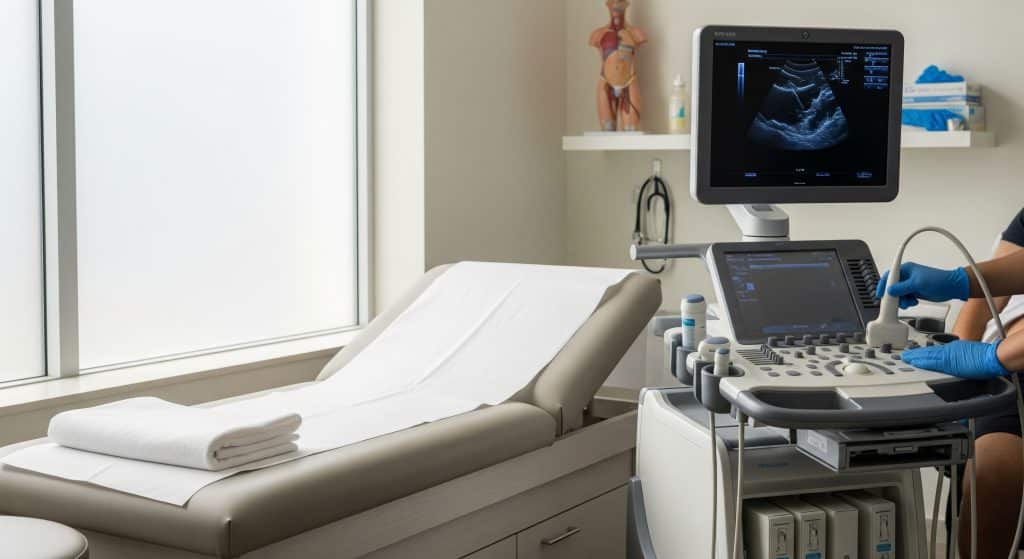
Ultrasound is the workhorse for scrotal assessment. As Ultrasonography of the Scrotum explains, high-frequency probes resolve anatomy and Doppler assesses perfusion. That allows you to exclude torsion and detect epididymitis or masses.
Hydroceles appear as simple anechoic collections surrounding the testis. As Radiopaedia notes, ultrasound also categorises congenital versus acquired forms. In acute pain, colour Doppler quickly distinguishes torsion from inflammation, as Doppler in Acute Scrotum shows. Imaging grounds your clinical impression of Hydrocele Symptoms in objective data.
Age-Specific Presentations
In newborns, most hydroceles are congenital and resolve within a year. As Boston Children’s notes, persistence or fluctuation suggests a communicating type. In older children, trauma or infection can trigger an acquired hydrocele.
Adults develop hydroceles from fluid imbalance or secondary causes. As StatPearls outlines, acquired cases may follow infection, tumour, or prior surgery. Context matters for interpreting Hydrocele Symptoms across age groups.
Hydrocele Treatment Options and Management
Watchful Waiting Approach
Observation is reasonable when symptoms are minimal and the diagnosis is secure. In paediatrics, resolution is common. As Selective Observation reports, about 60% of infant communicating hydroceles resolved without surgery. For abdominoscrotal variants, spontaneous resolution occurred in a minority, as Early Surgery vs Waiting found.
Adults with small, asymptomatic collections can also wait. As Case Resolution suggests, even large abdomino-scrotal cases may settle. Your threshold to shift from watchful waiting to active hydrocele treatment is persistent discomfort, rapid growth, or uncertain diagnosis.
Needle Aspiration
Needle aspiration removes fluid temporarily. It provides short-term relief when surgery is not possible. Recurrence is common because the sac lining continues to secrete fluid. In practice, aspiration alone is used selectively in high-risk surgical candidates or as a bridge to definitive care. Its role is limited for durable results compared to other hydrocele treatment options.
Sclerotherapy
Adding a sclerosant after aspiration reduces recurrence compared with aspiration alone. As Doxycycline Sclerotherapy reports, success reached about 84% after one treatment, with mild, transient pain as the main adverse effect. Another analysis showed a 76% success rate with sodium tetradecyl, and fewer complications than surgery, as Comparative Study notes.
Safety and day-case convenience are advantages, though recurrence is higher than after hydrocelectomy. As RCT Comparison found, sclerotherapy had fewer complications but higher early recurrences. For you, this means aligning Hydrocele Symptoms severity, recurrence tolerance, and logistics with the method chosen.
Hydrocele Surgery Types
Hydrocelectomy is the definitive operation for a durable cure. As Cleveland Clinic outlines, the procedure removes or everts the sac under anaesthesia and suits symptomatic or very large cases. Technique varies by size and wall thickness.
-
Jaboulay’s eversion for large, thick-walled sacs.
-
Lord’s plication for thinner sacs with less dissection.
-
Mini-incision plication (MIP) for selected adults, with fewer complications, as MIP Technique suggests.
Open scrotal hydrocelectomy remains standard for idiopathic testicular hydrocele in adolescents, as Adolescent Management notes. Technique selection balances recurrence risk, recovery time, and the character of your Hydrocele Symptoms.
Post-Operative Care
Structured aftercare reduces complications and speeds return to normal activities. As StatPearls advises, elevate the scrotum, use supportive underwear, and apply ice intermittently for the first 48 hours. Monitor for fever, wound redness, or enlarging swelling.
Complications are uncommon, but they do occur. As Complication Risk highlights, a meaningful subset of patients need unplanned care after surgery. Tailored follow-up, and conservative needle aspirations for post-operative collections, as Percutaneous Aspiration suggests, can minimise reoperation. Hydrocele Symptoms should recede steadily after the first week.
Treatment Outcomes and Recurrence Rates
Hydrocelectomy boasts the most durable cure. As Surg Endosc indicates, surgery reduces recurrence more effectively than aspiration and sclerotherapy. Patient satisfaction tends to be higher with surgery in longer follow-up.
Sclerotherapy offers lower upfront risk and cost, with higher recurrence. As Cochrane Review found, clinical outcomes were similar short term, but recurrence was markedly higher with sclerotherapy. Technique nuances matter too. As Urology Journal reports, Lord’s procedure showed lower recurrence and complication rates in one comparison.
|
Option |
Typical profile |
|---|---|
|
Watchful waiting |
Best for infants and small, asymptomatic adult cases. Reassess if Hydrocele Symptoms progress. |
|
Aspiration alone |
Temporary relief in high-risk patients. High recurrence. |
|
Sclerotherapy |
Day-case, fewer complications, higher recurrence than surgery. |
|
Hydrocelectomy |
Most durable cure with short recovery for fit candidates. |
Here is the practical reading. Align your tolerance for recurrence, perioperative risk, and how intrusive your Hydrocele Symptoms feel. Then choose the pathway that suits your priorities.
Conclusion
Scrotal swelling is not synonymous with hydrocele. Hernia, torsion, infection, trauma, and even cancer can look similar at first glance. A tight workflow protects you: examine carefully, use the transillumination rule, and confirm with ultrasound. Once you confirm testicular hydrocele, match hydrocele treatment to your symptoms, risks, and preferences. Relief is the goal. Precision is the path.
Frequently Asked Questions
Can hydrocele resolve without treatment?
Yes. In infants, spontaneous resolution is common by age one. In adults, small, painless collections may stabilise or shrink. Watchful waiting is reasonable when Hydrocele Symptoms are mild and imaging excludes other pathology.
What triggers sudden scrotal swelling in adults?
Common triggers include epididymitis, torsion, incarcerated hernia, trauma, or a haematocele. Hydrocele Symptoms usually build gradually, so a sudden onset demands urgent evaluation.
How can I differentiate between hydrocele and hernia at home?
A hydrocele often glows with a torch placed behind the scrotum. A hernia may reduce with gentle pressure and enlarge with coughing. These are clues only. Ultrasound confirmation is advised because misclassification carries risk.
Is hydrocele surgery painful?
Hydrocelectomy is performed under anaesthesia. Post-operative discomfort is expected for a few days and responds to simple analgesia and support garments. Most patients resume light activity within one to two weeks, depending on Hydrocele Symptoms beforehand and surgical technique.
Can hydrocele affect fertility?
Usually not. Hydroceles are fluid collections and typically spare sperm production. That said, very large sacs or associated conditions, such as infection or varicocele, can confound fertility planning. Address the underlying cause, not only the Hydrocele Symptoms.
When should I seek emergency care for scrotal swelling?
Seek urgent care for severe, sudden pain, nausea, a high-riding or very tender testis, fever with rigours, or an irreducible groin bulge. These features point away from simple Hydrocele Symptoms and toward torsion, infection, or incarcerated hernia.
Hydrocele Symptoms guide safe triage. Recognising Hydrocele Symptoms helps avoid delay. Document Hydrocele Symptoms with onset and fluctuation. Ultrasound clarifies Hydrocele Symptoms reliably. Discuss Hydrocele Symptoms before hydrocele surgery. Monitor Hydrocele Symptoms during recovery. Adults report Hydrocele Symptoms differently. Children display Hydrocele Symptoms subtly. Persistent Hydrocele Symptoms justify referral. Pain is not a classic part of Hydrocele Symptoms. Record Hydrocele Symptoms with size estimates. Night-time Hydrocele Symptoms can worsen comfort. Communicating types alter Hydrocele Symptoms pattern. Secondary causes can mimic Hydrocele Symptoms. Track Hydrocele Symptoms after sclerotherapy. Recurrent Hydrocele Symptoms suggest sac persistence. Bilateral Hydrocele Symptoms are uncommon. Trauma can modify Hydrocele Symptoms. Infection may intensify Hydrocele Symptoms. Varicocele can be confused with Hydrocele Symptoms. Document preoperative Hydrocele Symptoms. Reassess Hydrocele Symptoms at follow-up. Clear language about Hydrocele Symptoms supports consent. Hydrocele Symptoms affect clothing comfort. Quantifying Hydrocele Symptoms helps choose hydrocele treatment. Patients understand decisions when Hydrocele Symptoms are explained.
Related terms: testicular hydrocele, scrotal swelling, hydrocele surgery, hydrocele treatment.

