






 We do what's right for you...


How Mohs Surgery Treats Basal Cell Carcinoma Effectively
Dr. Payal Gupta
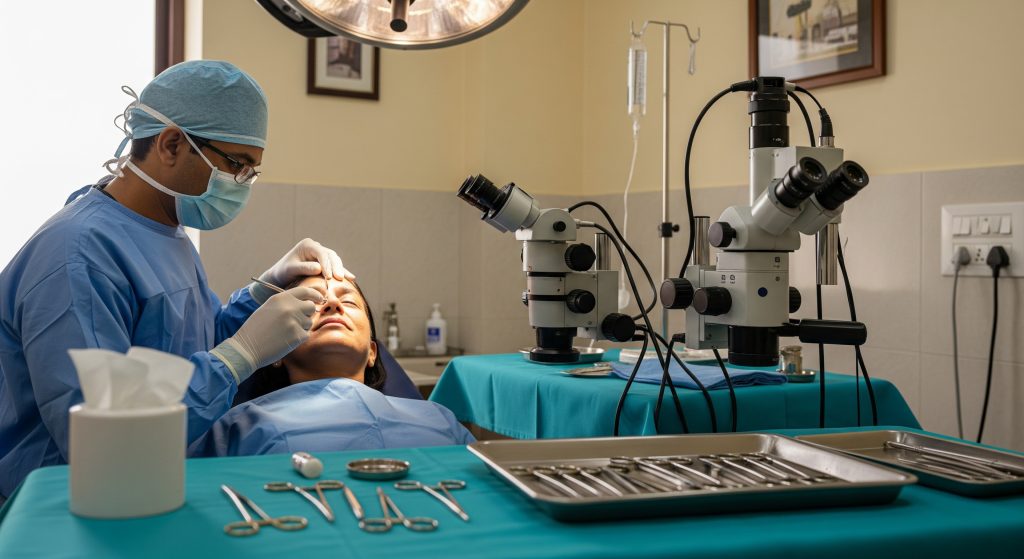
The usual advice is to excise and send to the lab. For basal cell carcinoma, that approach often leaves either too much cancer behind or too much healthy skin removed. In practice, mohs surgery for skin cancer delivers that precision with immediate microscopic control, superior cure rates, and better cosmetic outcomes. This explainer sets out what happens, why it works so well, and how to think about recovery and long term results.
Why Mohs Surgery Is Most Effective for Basal Cell Carcinoma
99% Cure Rate for Primary BCCs
Cure is the first priority. For primary basal cell carcinoma, the reported cure rate for mohs surgery for skin cancer reaches 99%. As StatPearls describes, that figure exceeds most alternatives and reflects the procedure’s complete margin control. The number matters because recurrence risk compounds over years. Lower early recurrence means fewer future procedures, fewer scars, and fewer clinic days.
That level of control sets expectations. I counsel patients that mohs surgery for skin cancer aims to finish cancer removal on the day of surgery, not a week later when a pathology report arrives. It is essentially on-table confirmation that the tumour is fully cleared. That certainty, even with a careful caveat about individual biology, is profoundly reassuring.
Tissue-Sparing Precision Technique
Basal cell carcinoma often sits on the nose, eyelids, or lips. In those areas, broad margins create avoidable deformity. The technique behind mohs surgery for skin cancer is intentionally conservative on healthy tissue. The surgeon removes a thin layer that includes the visible tumour and a small rim. The entire edge is examined under the microscope in real time. If cancer remains, only the mapped area is re-excised. This is targeted and efficient.
In practice, that means better function and appearance. I see patients keep the natural curve of the nostril, the crisp vermilion of the lip, or the fold of an eyelid. The tissue-sparing principle is not cosmetic vanity. It is medical prudence in an area with dense anatomy.
Complete Margin Control Advantage
Routine excision examines a sample of the margin. Mohs examines the complete margin. That is the core advantage. As Mayo Clinic explains, each layer is removed, oriented, and checked in full, and surgery stops only when no cancer cells are seen. Complete information drives accurate action. Partial information invites guesswork.
For mohs surgery for skin cancer, full margin control converts directly to lower recurrence. It also reduces the chance of a second, larger excision a month later. Patients avoid the emotional drag of waiting for a lab call and the practical cost of repeat theatre time.
Same-Day Cancer Removal Process
The process is iterative and disciplined. Surgeon remove a mapped layer, the lab prepares slides quickly, and read the margins. If cancer remains at 3 o’clock on the map, they remove another thin stage in that precise vector. The loop continues until the map is clear. The tumour is gone the same day. No guesswork, no blind margins.
Patients appreciate the cadence. There is a first numbing injection, a short stage, a waiting interval, and an update. Then perhaps one more stage. Then closure. The day feels purposeful. And yet, it is calm.
Best for High-Risk BCCs
Not all basal cell carcinomas behave the same. Infiltrative or morpheaform subtypes can send thin strands beyond obvious edges. Tumours in the so-called H-zone of the face also carry higher recurrence. For these high risk settings, mohs surgery for skin cancer is first-line choice. A systematic review indicates that mohs micrographic surgery reduces recurrence compared with standard excision, especially in head and neck disease, as NCBI reports. That aligns with real clinic experience.
Step-by-Step Mohs Micrographic Surgery Process
1. Initial Tumour Mapping
Surgeon begin by outlining the visible tumour and notable scar or pigment changes. A hand-drawn Mohs map mirrors the patient’s anatomy and records orientation. The specimen is inked to match the map. As NCBI details, accurate mapping links surgical edges to histology so he can target any positive margin on the very next stage.
This disciplined mapping underpins the whole method. It is basically the GPS for the cancer edges. Without the map, tissue-sparing intent becomes guesswork.
2. Layer-by-Layer Removal
The surgeon removes a thin saucer of tissue that includes the clinically apparent tumour. The depth is conservative unless there is perineural concern or prior radiation. For mohs surgery for skin cancer, the philosophy is minimal removal per stage with maximal information per slide.
-
Stage thickness is thin enough for orientation and fast processing.
-
Any prior biopsy site is encompassed to avoid skip areas.
-
Haemostasis is secured to protect specimen quality.
3. Microscopic Examination Phase
The lab flattens and freezes the tissue, allowing me to examine the entire peripheral and deep margin. They review tumour subtype and growth pattern, not just presence or absence. This is where mohs surgery for skin cancer differentiates itself. Real time pathology informs the next surgical move within minutes.
Complete margin visualisation is the technical hinge of mohs micrographic surgery. It converts uncertainty into a directed next step.
4. Additional Layer Removal
If the map shows residual tumour at a marked clock-face position, need to remove another narrow layer only in that direction. The rest of the wound is untouched. That targeted step may repeat once or twice until the board is clear. Patients often need two stages. Some need three. A few clear on the first stage.
The practical effect is twofold. Tissue loss stays low. Confidence in clearance stays high. For mohs surgery for skin cancer, that pairing is the point.
5. Wound Closure Options
Once margins are clear, the surgeon select the closure that best preserves contour and function. Options include direct side-to-side closure, local flaps, or skin grafts. On convex areas, a small flap often gives the best match. On concave areas, second intention healing can produce an excellent blend. The choice depends on site, tension vectors, and a patient’s preference.
-
Direct closure for small to moderate linear defects.
-
Local flap for shape-critical sites like the nasal ala.
-
Full thickness graft for thin eyelid skin, when needed.
-
Secondary intention for certain concave surfaces with low tension.
Mohs Surgery on Face vs Other Skin Cancer Treatment Options
Cosmetic Outcomes Comparison
Facial reconstruction is an art backed by anatomy. Mohs surgery on face preserves landmarks by removing only what needs to go. That precision widens closure options and shortens incision lines. Standard excision can work well on the trunk where laxity is abundant. On the nose or eyelid, extra millimetres translate into visible asymmetry.
Recurrence Rates Analysis
Roughly speaking, recurrence correlates with how completely a margin is assessed. Mohs examines the full margin, so recurrence is lower over five years. Standard excision samples the edge, so rare tumour tongues can persist. Radiotherapy can control BCCs in selected patients, yet long term salvage of recurrences can be complex.
For facial disease and high risk subtypes, I recommend mohs surgery for skin cancer because the balance of evidence and experience supports durable control. The method aligns surveillance and surgical certainty.
Treatment Duration Differences
Mohs surgery on face is a single session with staged cycles. Most cases finish in half a day. Excision is faster in theatre, though pathology reporting takes days and re-excision adds time if margins are positive. Topical therapies require weeks of adherence and leave uncertain depth control.
Time is not only clock time. It is also the time to definitive clearance. With mohs surgery for skin cancer, that time is often hours, not weeks.
Cost-Benefit Considerations
Cost-effectiveness hinges on avoiding recurrence and re-operation. Mohs has higher procedural complexity and requires an on-site lab. However, fewer repeat surgeries and smaller reconstructions can offset initial cost. For high risk facial BCCs, the value equation tends to favour mohs surgery for skin cancer over wider excision that risks either positive margins or larger defects.
|
Treatment |
Primary Benefit |
Key Limit |
|
Mohs micrographic surgery |
Complete margin control and tissue sparing |
Longer visit with staged processing |
|
Standard excision |
Faster theatre time |
Partial margin sampling and potential re-excision |
|
Radiotherapy |
Non-surgical option |
Delayed cosmetic changes and no margin histology |
|
Topical/ABLATIVE |
Non-invasive for selected superficial lesions |
Limited depth control and lower clearance for aggressive types |
The accountant’s view and the patient’s view converge here. Pay once for full clearance and a smaller repair. Avoid paying twice.
Recovery and Long-Term Results
First Week Healing Timeline
Day 0 to 1: swelling and a tight sensation are expected.We advise elevation and cold compresses. Day 2 to 3: bruising declares itself, especially around the eye or cheek. Day 4 to 7: sutures remain, discomfort fades, and normal activity resumes with simple precautions. The typical first review occurs at one week for suture removal and wound check.
For mohs surgery for skin cancer, this first week is structured. Clear instructions reduce avoidable complications. Patients return to desk work quickly, while heavy exertion waits until sutures are out.
Scar Management Techniques
Scar quality depends on meticulous closure and consistent aftercare. Usually surgeon uses fine sutures, evert edges, and align lines with natural creases. Patients then take over. The essentials are simple:
-
Daily gentle cleansing once cleared to do so.
-
Petroleum-based ointment until epithelialised.
-
Silicone gel or sheets from week two to week eight.
-
Sun protection, ideally SPF 50, for at least six months.
-
Scar massage from week three if the wound is stable.
When a scar remains raised at three months, I consider intralesional steroid or fractional laser. For mohs surgery for skin cancer on the face, early intervention preserves the subtle contour.
Follow-Up Schedule Requirements
Basal cell carcinoma has a lifelong tendency to recur or new primaries to appear. I schedule follow up at three months, six months, and then annually, with adjustments for risk profile. Those with multiple lesions, immunosuppression, or significant sun exposure merit closer review.
A structured schedule pairs with education. I show patients how to spot pearly papules, non-healing edges, or new telangiectasia. Early detection keeps future mohs surgery for skin cancer straightforward.
Prevention of New BCCs
Prevention is not perfect, yet it helps. Photoprotection is foundational: clothing, hats, shade, and sunscreen. For field cancerisation, we use topical agents or photodynamic therapy where appropriate. I also focus on habit change. Midday outdoor work without protection is a preventable risk.
Good prevention means fewer procedures. It also means that if mohs surgery for skin cancer is required again, the lesion is found early and remains small.
Making the Right Choice for BCC Treatment
Choice hinges on tumour risk, location, and patient priorities. For low risk trunk lesions, a well planned excision is reasonable. For facial, recurrent, or aggressive subtypes, I recommend mohs surgery for skin cancer because it unites complete margin control with tissue preservation. That combination protects cure and appearance.
If unsure, ask two questions. Will the entire margin be assessed today. Will the plan preserve as much normal skin as possible. If the answer to both is yes, that pathway is likely sound. In many cases, that pathway is mohs micrographic surgery.
Frequently Asked Questions
How painful is Mohs surgery for skin cancer?
Discomfort is modest. Surgeon use local anaesthetic to numb the area fully. Patients feel pressure, not pain, during stages. After surgery, paracetamol usually suffices. On the face, bruising can look dramatic for a few days, yet pain scores remain low.
Can basal cell carcinoma return after Mohs surgery?
Recurrence after mohs surgery for skin cancer is uncommon, particularly for primary BCCs. It can still occur, especially with aggressive histology or prior radiation, though the risk is low compared with other methods. Ongoing skin checks remain essential because new lesions may develop elsewhere.
How long does Mohs micrographic surgery take?
Plan for half a day. Most cases finish within two to four hours. Each stage takes roughly 45 to 60 minutes, including processing and microscopic assessment. Complex reconstructions or multi-stage cases can extend longer.
What size scar will Mohs surgery leave?
Scar size depends on tumour size, depth, and the closure method. Mohs surgery on face tends to create smaller defects because less healthy tissue is removed. We align closures with natural lines to minimise visibility. Final scars usually soften and fade over three to six months, with continued improvement to one year.
Can I drive home after Mohs surgery?
It is better to arrange a ride. Facial swelling, eye dressings, or sedation, if used, can impair safe driving. Even without sedation, a support person helps with logistics and postoperative care. The journey home is not the moment to test depth perception.

