






 We do what's right for you...


How Elbow Pain Treatment Works: From Diagnosis to Recovery
Dr. Neetan Sachdeva
Rest is often presented as the cure for elbow problems. It rarely is on its own. Effective care demands precise diagnosis, staged rehabilitation, and measured return to load. In this explainer, I outline how elbow pain treatment progresses from first assessment to full recovery, including where surgery fits and how to reduce the risk of recurrence.
Treatment Options for Common Elbow Conditions
Tennis Elbow Treatment Methods
Lateral epicondylalgia is the clinical name for tennis elbow. I prioritise load management and progressive strengthening because they address tendon capacity, not just pain. For structured elbow pain treatment, I start by identifying provocative tasks and reducing their frequency and intensity for a short period, usually 2 to 3 weeks.
-
Relative rest from high-load gripping and wrist extension.
-
Isometric holds for pain relief, then isotonic strengthening for capacity.
-
Gradual reintroduction of task-specific loading and grip work.
Topical NSAIDs can help with symptom control. I consider counterforce bracing for high-demand tasks, though I avoid long-term reliance. For athletes, I adjust equipment and technique to reduce peak tendon strain. Injections may provide temporary relief but do not replace strengthening. As capacity improves, I integrate elbow pain exercises that mimic real tasks, such as controlled eccentric wrist extensions with a dumbbell.
For persistent cases beyond 12 weeks, I reassess biomechanics, cervical and shoulder contribution, and adherence. This is where targeted tennis elbow treatment often succeeds: a deliberate progression, not passive modalities alone.
Golfer’s Elbow Management
Medial epicondylalgia behaves similarly but stresses wrist flexors and pronators. I adopt the same principles with different exercise vectors. Early care focuses on reducing provocative wrist flexion and forearm pronation under load. Then I add graded strengthening for the flexor-pronator mass and forearm rotation control.
-
Isometric wrist flexion holds for analgesia.
-
Eccentric wrist flexion and pronation with low loads and high control.
-
Grip endurance work once pain has settled to a tolerable level.
Technique errors in sport or work tasks often sustain irritation. I address swing mechanics or repetitive tool use as needed. Manual therapy can modulate symptoms, but I frame it as an adjunct. The foundation remains a progressive plan inside a coherent elbow pain treatment pathway.
Bursitis Treatment Approaches
Olecranon bursitis presents with swelling at the tip of the elbow. If non-infective, I prioritise compression, protection from direct pressure, and activity modification. NSAIDs can assist. Aspiration is occasionally required to relieve significant swelling, though I weigh infection risk carefully.
If infection is suspected, I escalate to urgent medical review for antibiotics. I discourage repeated friction at the posterior elbow, including leaning on hard surfaces. Once inflammation settles, I address any strength or mobility deficits that increase mechanical irritation. That is how bursitis fits into broader elbow pain treatment: manage the acute issue, then reduce the drivers.
Arthritis Pain Relief Strategies
Elbow osteoarthritis or inflammatory arthritis causes stiffness and activity pain. The goals are symptom control, function preservation, and flare prevention. I use a combination of load modification, joint-friendly strength work, and mobility drills within pain tolerance.
-
Short courses of NSAIDs if appropriate and medically cleared.
-
Heat for stiffness and ice for reactive flares.
-
Strengthening of triceps, biceps, and forearm musculature with controlled range.
In select cases, guided injections may help. For end-stage disease with severe restriction, surgical options exist, including debridement or arthroplasty. I time rehabilitation to optimise joint stability before and after any intervention. The path remains structured elbow pain treatment with realistic, staged goals.
Nerve Entrapment Solutions
Ulnar neuropathy at the cubital tunnel and radial tunnel irritation require careful differential testing. I reduce compressive and traction loads by avoiding prolonged elbow flexion and direct pressure on the ulnar groove. Night splinting in slight extension can help reduce nocturnal symptoms.
-
Neural interface management: gentle slider and tensioner drills, not aggressive stretching.
-
Posture and workstation changes to reduce nerve compression time.
-
Progressive strengthening to restore dynamic control without provoking neural symptoms.
Persistent weakness, atrophy, or sensory changes warrant specialist review. Surgery is occasionally indicated if conservative care fails. Even then, prehabilitation supports outcomes. I keep nerve health central within elbow pain treatment, as neural irritability easily derails progress.
Fracture and Dislocation Care
Acute trauma changes the equation. I prioritise protection, imaging, and orthopaedic assessment. Stable, non-displaced fractures may be managed conservatively with immobilisation and staged rehabilitation. Dislocations require reduction and careful follow up to detect instability or ligament injury.
Once cleared, I progress through pain-limited range, isometrics, and gradual strengthening. Early overconfidence risks stiffness or instability. Conversely, excessive immobilisation invites long-term loss of motion. The balance is precise. Good elbow pain treatment is often conservative, but it is never casual.
Diagnosis and Assessment Process
Physical Examination Techniques
I begin with pattern recognition: symptom location, aggravating tasks, time course, and red flags. Then I test specific structures with stress positions and resisted movements. Palpation helps localise tenderness but is not diagnostic on its own.
-
Resisted wrist extension and passive wrist flexion for lateral tendinopathy.
-
Resisted wrist flexion and pronation for medial tendinopathy.
-
Valgus stress for UCL integrity and apprehension for instability.
-
Tinel sign at the ulnar groove for nerve irritability.
I also screen cervical and shoulder regions. Referred pain can mislead. A structured exam clarifies elbow pain causes and guides a targeted elbow pain treatment plan.
Imaging Tests Required
I reserve imaging for atypical presentations, trauma, or poor progress after initial care. Plain radiographs assess fractures, osteophytes, and joint space. Ultrasound can show tendon thickening or tears and guide injections. MRI helps evaluate complex cases, cartilage, ligaments, and occult pathology.
Imaging supports the diagnosis but does not replace clinical reasoning. When images and symptoms conflict, I re-examine. Precision matters here. It is basically pattern, load, response, then imaging if needed.
Differential Diagnosis Considerations
Key differentials include cervical radiculopathy, referred pain from the shoulder, nerve entrapments, and intra-articular pathology. Red flags such as systemic symptoms, marked swelling with fever, or progressive neurological deficit shift the plan immediately.
I also consider less common sources: stress fractures in throwers, synovial plica, and early inflammatory arthritis. Clear differentiation prevents misguided elbow pain treatment and shortens the road to recovery.
When to Seek Specialist Consultation
I refer to orthopaedics or rheumatology when structural damage, instability, or inflammatory disease is suspected. Persistent functional limitation beyond 12 to 16 weeks despite adherence also prompts referral. Progressive weakness, numbness, or nocturnal pain with hand wasting requires urgent evaluation.
Specialist input does not stop rehabilitation. It refines it. The best outcomes arise when surgical, medical, and rehabilitation plans align within a single elbow pain treatment strategy.
Recovery Timeline and Rehabilitation
Initial Rest and Protection Phase
The first 1 to 3 weeks typically focus on symptom control and load reduction. I prefer relative rest over complete inactivity. I protect the irritated tissue while maintaining general conditioning and pain-free range.
-
Adjust tasks, loads, and work setups to reduce peak stress.
-
Use ice or heat based on individual response for brief relief.
-
Introduce gentle range drills below pain threshold.
This is where disciplined elbow pain treatment begins. I set clear boundaries and simple progress markers to avoid either stagnation or overreach.
Therapeutic Exercises for Strength
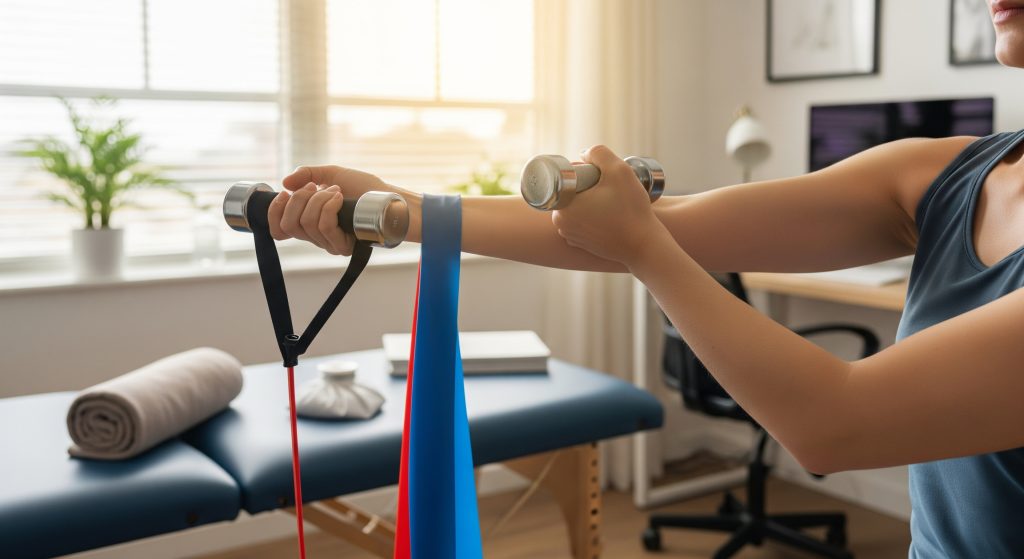
Once pain settles to a manageable level, I shift to capacity building. Tendons adapt to load. They require it. I prescribe progressive resistance for wrist extensors or flexors, forearm rotation, and elbow flexion and extension. I keep tempo slow for control and tissue time under tension.
-
Isometric holds: 30 to 45 seconds for 4 to 5 sets.
-
Isotonic progressions: 8 to 12 reps with measured eccentric phases.
-
Grip endurance: timed holds and dynamometer-guided targets if available.
These are the core elbow pain exercises that change capacity and tolerance. I add scapular and shoulder work to distribute load more evenly. It reduces recurrence to an extent and improves performance in demanding tasks.
Range of Motion Restoration
Elbows lose extension quickly when irritated or immobilised. I prioritise extension first, then flexion, then rotation. Short, frequent sessions outperform occasional longer sessions. Joint-friendly mobilisations and low-load prolonged stretches help regain end range without flare ups.
If stiffness persists, I consider adjuncts like low-grade joint mobilisation. I avoid aggressive stretching that triggers protective guarding. Range returns, then strength consolidates. That sequence stabilises elbow pain treatment outcomes.
Return to Activity Guidelines
Return is a process, not a switch. I use objective and subjective criteria before advancing. Pain must be low and stable, function reliable, and load tolerance proven in practice drills.
|
Criterion |
Standard |
|---|---|
|
Pain at rest |
None or minimal, predictable with load |
|
Strength |
Within 10 to 15 percent of the unaffected side |
|
Range |
Functional range restored for task demands |
|
Task test |
Can complete task sequence without symptom spike |
I reintroduce volume before intensity, then complexity. For racquet sports, I progress from shadow swings to light rallies, then match play. For manual workers, I rebuild shift tolerance with micro breaks and ergonomic fixes. This is where elbow pain treatment meets real life, and where meticulous planning pays off.
Prevention of Re-injury
Recurrence usually reflects mismatched capacity and demand. I set maintenance strength targets and schedule periodic deload weeks. Equipment and technique matter, particularly in sport and repetitive trade work.
-
Keep two pulling patterns and two pushing patterns in weekly training.
-
Maintain forearm rotation strength and grip endurance.
-
Limit sudden workload spikes beyond 15 to 20 percent per week.
Ergonomic review reduces unnecessary strain. Education closes the loop. Prevention is simply ongoing elbow pain treatment, spaced out and scaled down.
Conclusion
Effective elbow pain treatment is not mysterious. Diagnose accurately, protect short term, build capacity patiently, and return to load methodically. Imaging supports clarity when needed. Injections and surgery have roles but do not replace disciplined rehabilitation. With a pragmatic plan, most cases improve substantially, and many return to full activity with confidence.
Frequently Asked Questions
How long does elbow pain treatment typically take?
Most uncomplicated tendinopathy improves over 6 to 12 weeks with consistent loading and symptom management. Bursitis may settle within 2 to 4 weeks if non-infective. Nerve entrapments vary and can require several months. Traumatic injuries follow healing timelines set by tissue and fixation. I individualise targets and monitor milestones rather than promising a fixed date.
Can I treat elbow pain at home without seeing a doctor?
Many mild cases respond to structured self-management. Reduce provocative loads, apply brief symptom relief, and start graded strengthening. If symptoms persist beyond 4 to 6 weeks, worsen, or involve numbness or weakness, seek assessment. Home care is part of elbow pain treatment, but it is not a replacement for diagnosis when red flags appear.
What are the warning signs that elbow pain needs immediate medical attention?
Red flags include severe pain after trauma, visible deformity, marked swelling with fever, inability to move the elbow, or progressive numbness and weakness. Sudden locking or catching after injury also warrants urgent review. These signs suggest structural or infective issues where delayed care carries risk.
Will I need surgery for my elbow pain?
Surgery is seldom required for lateral or medial tendinopathy. Most improve with a rigorous strengthening plan. Surgery becomes relevant for mechanical blocks, severe arthritis, unstable injuries, or persistent nerve compression with a deficit. I make referrals when non-operative elbow pain treatment fails despite good adherence and time.
How can I prevent elbow pain from returning after treatment?
Maintain strength in the wrist extensors and flexors, forearm rotation, and scapular stabilisers. Progress workload gradually and avoid large spikes. Review equipment and technique if sport is involved. Keep a short list of elbow pain exercises as routine maintenance. Prevention is an ongoing commitment, not a one-off fix.

