






 We do what's right for you...


Golfers Elbow Exercises Explained: What Really Works?
Dr. Beenish Khan


Rest alone is often promoted as the fix for persistent elbow pain. In practice, deconditioning follows and the pain returns the moment load resumes. I take a different view. Well-chosen golfers elbow exercises, progressed with care, rebuild capacity and reduce symptoms in a reliable way.
Top Exercises for Golfers Elbow Relief
1. Eccentric Wrist Flexor Strengthening
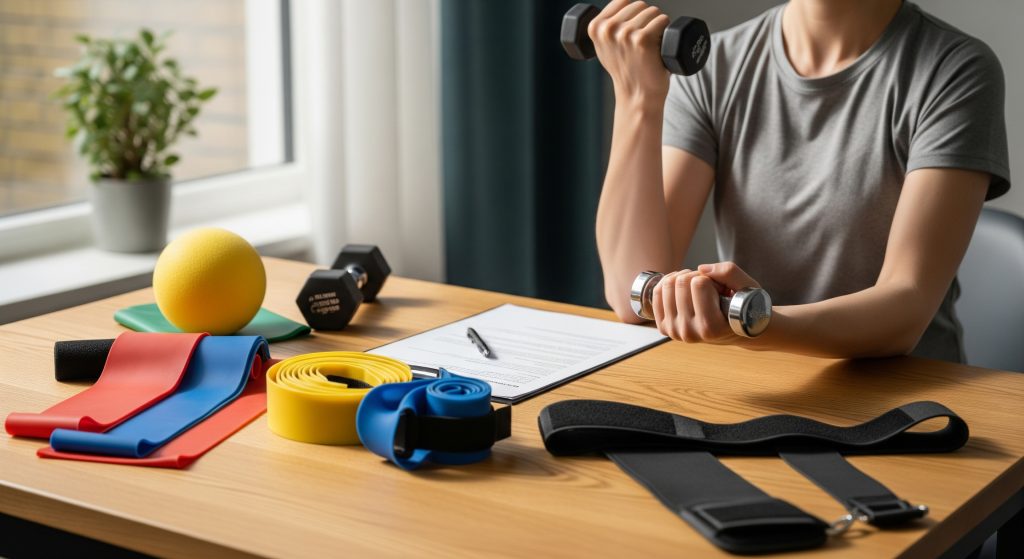
I start with eccentrics because they target tendon load tolerance. They also respect pain limits. Use a light dumbbell.
-
Sit with the forearm supported, palm up, wrist over the edge.
-
Use the other hand to lift the dumbbell into wrist flexion.
-
Slowly lower through wrist extension for 3 to 5 seconds.
-
Dosage: 3 sets of 8 to 12 slow lowers. Aim for a mild ache, not sharp pain.
-
Progression: Increase weight in small steps when lowering feels steady.
-
Cue: Keep the forearm quiet. The wrist does the work.
Here is why this matters. Eccentrics build tendon resilience and reduce fear of movement. Controlled loading beats passive rest for meaningful change.
2. Wrist Flexor Stretches
Stretching restores comfortable range and reduces protective guarding. Technique quality matters more than intensity.
Extend the arm, palm up, and gently draw the fingers back with the other hand. As Mayo Clinic describes, this position lengthens the wrist flexors without forcing the joint. For time under stretch, I use the simple protocol many clinics suggest. Hold for 30 seconds and repeat 3 times, as Athletico outlines for routine mobility work.
-
Dosage: Daily on training days, twice on non-training days if stiffness lingers.
-
Intensity: Gentle pull only. No pinching at the elbow.
-
Integration: Pair each set with breathing to reduce tone.
This is one of the simplest golfers elbow exercises to implement. It is also easy to maintain during busy periods.
3. Pronation and Supination Exercises
Rotational control is frequently overlooked. Yet it matters for swinging, lifting, and daily grip tasks.
Seated, support the forearm. Use a light hammer or band. Roll the palm inward against resistance for pronation, then outward for supination. The sequence builds balanced strength across the forearm. As MyHealth Alberta explains, resisted pronation and supination strengthen the pronator and supinator groups when performed with steady control.
-
Dosage: 2 to 3 sets of 10 controlled reps each direction.
-
Progression: Lengthen the lever arm on a hammer before adding weight.
-
Cue: Keep the elbow near the body to avoid compensation.
I place these early in a plan. Stronger rotation reduces strain on the irritated tendon during gripping.
4. Isometric Wrist Flexion Holds
Isometrics calm pain sensitivity and provide an entry point on sore days. They also build force at a safe joint angle.
-
Rest the forearm on a table, palm up.
-
Press the palm into an immovable object or your other hand.
-
Hold the effort for 30 to 45 seconds at a comfortable intensity.
-
Dosage: 3 to 5 holds, one to two times per day during a flare.
-
Intensity: About 30 to 60 percent effort. Scale to symptoms.
-
Progression: Move to heavier dynamic work once pain eases.
When pain is sensitive, these golfers elbow exercises provide a stable base. Relief within minutes is common, though not universal.
5. Finger Extension with Resistance Band
Counterbalance matters. The flexors grip hard. The extensors must keep pace to share load across the forearm.
-
Place a small loop band around the fingers.
-
Open the hand against the band. Pause briefly at the end.
-
Control the return to the starting position.
-
Dosage: 2 to 3 sets of 15 to 20 reps. Moderate burn is acceptable.
-
Progression: Increase band tension or use a stiffer extender.
-
Cue: Spread the fingers evenly. Do not shrug the shoulder.
These are efficient golfers elbow exercises when time is limited. I often prescribe them between heavier sets to build capacity quietly.
6. Ball Squeeze Progressions
Grip strength must return to match daily demands. I use a graded squeeze approach to track progress.
-
Start with a soft foam ball. Squeeze for 5 seconds. Relax for 5 seconds.
-
Move to a firmer ball or gripper over time.
-
Finish with holds that mimic real tasks, such as carrying a bag.
-
Dosage: 3 sets of 10 timed squeezes, then 3 longer holds of 20 to 30 seconds.
-
Progression: Increase density rather than peak force early on.
-
Cue: Keep the wrist neutral. Avoid bending to find leverage.
Simple, measurable, and transferable to the course. That is the appeal of these golfers elbow exercises.
7. Nerve Gliding Exercises
Some presentations include nerve sensitivity. Gentle glides can reduce symptoms that feel like diffuse forearm tightness.
-
Median nerve glide: Shoulder down, elbow extended, palm open. Tilt the head away gently while extending the wrist. Reverse smoothly.
-
Ulnar nerve glide: Shape the hand like a mask, elbow bent, wrist extended. Rotate the forearm and lightly side bend the neck.
-
Dosage: 10 controlled reps, once or twice daily on sensitive days.
-
Rule: Glides should be smooth and symptom neutral. No aggressive holds.
These are adjuncts to other golfers elbow exercises, not replacements. Use them when neural irritability is present.
Advanced Strengthening Programme for Full Recovery
Progressive Loading Phases
Rehabilitation succeeds when load matches tissue capacity. To an extent, timing beats intensity.
|
Phase |
Focus and Criteria |
|---|---|
|
Phase 1 – Settle and Activate |
Pain modulation with isometrics and light range. Criteria to progress: daily tasks are tolerable and morning soreness minimal. |
|
Phase 2 – Build Control |
Eccentric wrist flexion, pronation and supination, light grip work. Criteria: complete 3 sessions per week with stable symptoms. |
|
Phase 3 – Strength and Endurance |
Heavier eccentrics, concentric tempo work, sustained grips. Criteria: load increases for two weeks without regression. |
|
Phase 4 – Power and Return |
Plyometric dribbles, med ball patterns, swing tempo drills. Criteria: sport drills at practice volume with next day comfort. |
These phases organise golfers elbow exercises into a clear path. It is basically load management that respects biology.
Grip Strength Rehabilitation Stages
-
Isometric squeezes: Low to moderate force. Hold 20 to 40 seconds.
-
Rhythmic squeezes: 10 to 20 reps with even tempo. Emphasise control.
-
Endurance carries: Farmer carry light kettlebells for 30 to 60 seconds.
-
Power pulses: Short, crisp squeezes for reaction and release.
-
Measurement: Track perceived exertion and morning response.
-
Progression: Increase duration first, then load, then speed.
Stronger grip safeguards the flexor tendon. These stages pair well with the earlier golfers elbow exercises.
Kinetic Chain Exercises for Elbow Support
Elbow symptoms often reflect upstream and downstream issues. Shoulders and trunk absorb force so the elbow does not have to.
-
Scapular control: Wall slides, serratus punches, prone Y holds.
-
Rotator cuff strength: Side-lying external rotation, cable ER with towel.
-
Trunk power: Anti-rotation press, split-stance chops, hip hinge patterns.
Example: A steady half-kneeling chop teaches force transfer from hip to hand. The elbow gets stability for free. And yet, overloading the elbow early will derail this benefit.
Sport-Specific Movement Patterns
Sport drills convert strength into skill. I build these once symptoms are quiet at rest and under submax load.
-
Tempo swings: Partial swings at 50 to 70 percent with smooth acceleration.
-
Impact sequencing: Slow backswing, pause, crisp downswing with soft finish.
-
Course simulation: Practice nine holes worth of swings with planned rest.
Integrate these with the core golfers elbow exercises. The handoff from rehab to performance should feel seamless.
Golfers Elbow Treatment Beyond Exercise
Choosing the Right Golfers Elbow Brace
A forearm strap can reduce peak tendon load during tasks. Selection is straightforward if principles are clear.
-
Type: Counterforce strap worn 2 to 3 finger widths below the inner elbow.
-
Fit: Snug, not tight. Numbness or finger tingling means loosen the strap.
-
Use: Wear during higher load periods only. Remove at rest.
A golfers elbow brace assists but does not replace training. I position it as a short-term tool within a broader plan.
Ice and Heat Therapy Protocol
I use simple thermal rules. Cold reduces flare symptoms. Heat improves comfort before mobility work.
-
Cold: 10 to 15 minutes post activity during flares. Use a thin barrier to protect skin.
-
Heat: 10 minutes before mobility or isometrics. Warmth eases entry into range.
-
Alternating: Not mandatory. Use if it clearly helps recovery.
Thermal modalities are supportive. The main driver remains well-dosed golfers elbow exercises.
Activity Modification Guidelines
Complete rest stalls progress. Smart modification maintains fitness and reduces aggravation.
-
Reduce intensity, not all activity. Lower swing speed or bucket volume.
-
Switch grip or use larger handles where possible to share load.
-
Break tasks into shorter blocks with planned micro rests.
Think dial, not switch. Continue with neutral tasks while heavy elbow work is scaled down.
When to Seek Professional Treatment
Most cases respond to a structured plan. Intervention is advisable if progress stalls.
-
Red flags: Night pain that does not settle, significant weakness, or spreading numbness.
-
Plateau: No improvement after 6 to 8 weeks of consistent loading and mobility.
-
Complexity: Coexisting neck or shoulder issues complicating symptoms.
Hands-on assessment refines golfers elbow treatment when the typical pathway falters. Early advice can prevent a chronic cycle.
Golfers Elbow vs Tennis Elbow Key Differences
Location and Pain Patterns
|
Aspect |
Golfers Elbow |
Tennis Elbow |
|---|---|---|
|
Pain location |
Inside of the elbow at the medial epicondyle |
Outside of the elbow at the lateral epicondyle |
|
Aggravating tasks |
Wrist flexion, forearm pronation, strong gripping |
Wrist extension, forearm supination, lifting with palm down |
|
Common feel |
Ache that sharpens with resisted wrist flexion |
Twinge with resisted wrist extension or gripping a kettle |
The differences guide targeted loading. Precision limits needless irritation.
Affected Tendons and Muscles
-
Golfers elbow: Common flexor origin, often pronator teres and flexor carpi radialis involvement.
-
Tennis elbow: Common extensor origin, especially extensor carpi radialis brevis.
This matters because tendon direction and role influence exercise choice. And it explains why rotation work supports both conditions.
Exercise Modifications for Each Condition
For golfers elbow:
-
Prioritise eccentric wrist flexion and pronation strength.
-
Use a counterforce strap during high-load gripping.
-
Stretch wrist flexors with measured holds before loading.
For tennis elbow:
-
Switch to eccentric wrist extension and gradual supination strength.
-
Adopt thicker grips to reduce extensor demand during carries.
-
Stretch wrist extensors and monitor next day response.
If uncertain about golfers elbow vs tennis elbow, trial the modified patterns above. The right set should feel challenging yet manageable.
Conclusion
Effective rehabilitation is not mysterious. It is a disciplined use of golfers elbow exercises, layered with smart progressions and supported by simple tools. Start with pain-tolerant loading, restore rotation, then build grip endurance and power. Use a golfers elbow brace when tasks spike and step it down as strength returns. Finally, refine sport patterns so strength translates into performance. Healthy tendons prefer steady work. Give them that, and they adapt.
Frequently Asked Questions
How long should I do golfers elbow exercises before seeing improvement?
Most individuals notice steadier symptoms within 2 to 4 weeks, though timelines vary. Early sessions focus on isometrics and gentle range. By weeks 4 to 8, eccentrics and grip endurance usually deliver visible progress. If nothing changes by week 6, adjust load or seek a review.
Can I continue playing golf whilst doing these exercises?
Yes, with modifications. Reduce swing volume and tempo, and schedule practice after isometrics when pain is calmer. Keep training on non-consecutive days to monitor next day response. If a session increases morning pain markedly, scale the next one.
Should golfers elbow exercises cause pain?
A mild, tolerable ache during and shortly after loading is acceptable. Sharp, spreading, or night pain is not. Use a simple rule. Pain should settle to baseline within 24 hours. If it lingers beyond that window, reduce volume or intensity.
What’s the best single exercise for golfers elbow?
The best single option is eccentric wrist flexion with slow lowers. It targets the involved tendon and builds load tolerance. That said, rotation strength and grip endurance are necessary complements. One exercise rarely covers all needs.
How often should I perform these exercises daily?
For symptom relief, use isometrics once or twice daily during flares. For capacity, perform the main strengthening plan three times weekly, leaving at least a day between sessions. Stretching and light rotation work can be done more frequently if symptoms allow.
Can these exercises prevent golfers elbow from returning?
They reduce risk significantly by restoring strength, rotation control, and endurance. Prevention also relies on load management, seasonal ramp-up planning, and grip variety. A periodic check-in every 6 to 8 weeks keeps the programme aligned with current demands.

