






 We do what's right for you...


First Trimester Ultrasound: What to Expect & Why It Matters
Dr. Beenish Khan


Routine advice often reduces the first trimester ultrasound to a quick check for a heartbeat. That view misses its real value. This scan anchors the pregnancy timeline, screens for important risks, and establishes a baseline for care. In this guide, I explain how each scan fits together, what I look for during the appointment, and how to read the results with calm precision.
Types of First Trimester Ultrasounds and Their Timing
When I plan first trimester ultrasound appointments, I structure them around clinical questions and precise windows. Each scan answers something specific. It is basically a staged assessment that builds confidence step by step.
Early Pregnancy Ultrasound (6-9 Weeks)
An early pregnancy ultrasound helps confirm the location of the gestational sac, identify the yolk sac, and look for early cardiac activity. I request this scan if there is pain, bleeding, uncertainty about dates, or prior pregnancy loss. In some cases, I choose a transvaginal approach for clarity. The aim is simple. Confirm a viable intrauterine pregnancy and establish an initial timeline.
-
What I expect to see: sac, yolk sac, and a developing embryo.
-
What I record: sac position, crown-rump length (CRL) when visible, and presence of cardiac activity.
-
When I bring you back: usually within one to two weeks if the view is too early.
Although reassurance matters, I remain careful with language at this stage. Biology sometimes runs slower than the calendar suggests. A repeat first trimester ultrasound can clarify viability with less ambiguity.
Dating Scan Pregnancy (8-14 Weeks)
The dating scan pregnancy establishes gestational age with a high degree of reliability. I prioritise CRL measurement because it is the most precise early metric for due date estimation. If the measured age differs meaningfully from the last menstrual period, I base the plan on the ultrasound result.
-
Primary purpose: fix the due date and review early anatomy.
-
What I capture: CRL, cardiac activity, and basic checks on the uterus and adnexa.
-
Follow-up: scheduling of later structural assessment at 18-22 weeks.
This first trimester ultrasound is the anchor for all downstream appointments. The accuracy here reduces cascade errors later in pregnancy.
Nuchal Translucency Scan (11-14 Weeks)
The nuchal translucency scan evaluates the fluid space at the back of the fetal neck and integrates with maternal age and blood biomarkers where applicable. It is a screening test, not a diagnosis. As NHS sets out, this scan is performed between 11 and 14 weeks and contributes to combined screening for chromosomal conditions.
-
Core readouts: CRL, nuchal translucency measurement, and nasal bone visualisation where feasible.
-
Outcome: personalised risk estimate for conditions such as trisomy 21.
-
Next step: targeted diagnostic testing if the risk is high.
I position this first trimester ultrasound as part of layered screening. It guides decisions about non-invasive prenatal testing or diagnostic procedures.
Additional Scans for High-Risk Pregnancies
For high-risk pregnancies, I tailor frequency and focus. Repeat first trimester ultrasound may be indicated to track viability or to assess specific concerns. I also time detailed checks to the narrow windows where visibility of certain structures is optimal. As NCBI summarises, structured timing in early pregnancy supports early identification of problems and more informed planning.
-
Who I consider high risk: those with prior losses, IVF conceptions, significant medical conditions, or worrisome early symptoms.
-
What changes: additional imaging to watch development, and earlier referrals when indicated.
-
Why it matters: risk management improves when small trends are detected early.
In practice, the right scan at the right time reduces uncertainty. And yet, I avoid over-scanning without a clear clinical question.
What Happens During Your First Trimester Ultrasound
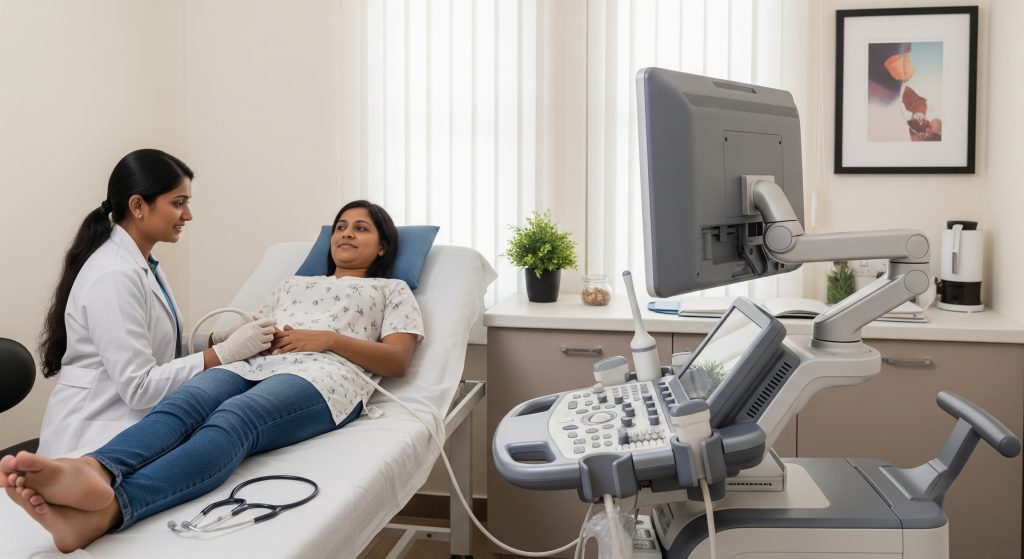
A first trimester ultrasound is systematic. I set up the image, run through a defined checklist, and document measurements that will shape the care plan. The process is predictable, which helps most people relax.
Transvaginal vs Transabdominal Approach
I choose a transvaginal scan for very early gestations or when abdominal imaging does not provide sufficient detail. It places the probe closer to the uterus, producing sharper early images. A transabdominal first trimester ultrasound works well once the pregnancy is a little further along. A full bladder can help by providing an acoustic window. The decision is pragmatic. I use the method that best answers the question on the table.
-
Transvaginal: clearest early view, especially before 9 weeks.
-
Transabdominal: more comfortable once the uterus rises above the pelvis.
-
Occasional combination: start abdominal, complement with transvaginal if needed.
Measurements and Checks Performed
My checklist is consistent, with small adjustments for clinical context. Every first trimester ultrasound aims to document viability and dating, then expand into screening.
|
Measurement or check |
Purpose |
|---|---|
|
Crown-rump length (CRL) |
Primary basis for due date in early gestation. |
|
Fetal heartbeat |
Confirms viability and informs follow-up interval. |
|
Gestational sac and yolk sac |
Confirms intrauterine location and physiological progression. |
|
Nuchal translucency |
Screens for chromosomal and cardiac risk indicators. |
|
Uterus, cervix, and adnexa |
Checks for fibroids, cysts, or other findings that influence management. |
When I complete the scan, I revisit any ambiguous images. Precision now prevents confusion later.
How Long Each Scan Takes
The duration depends on gestational age, fetal position, and whether I use abdominal or transvaginal imaging. In clinic, the typical first trimester ultrasound appointment takes under half an hour. As Mayo Clinic notes, most first trimester scans fall within roughly 20 to 30 minutes, allowing time for due date estimation and basic checks.
-
Early viability scans are often the shortest.
-
Combined screening scans take longer due to measurements and image quality standards.
-
Repeat imaging may be needed if the view is suboptimal.
Time is not the goal, image quality is. I will take longer if clarity demands it.
Understanding Your Ultrasound Report
The report distils a lot of information into a concise format. I write it so the next clinician can make decisions without guesswork. Here is how I suggest reading it.
-
Gestational age and due date: anchored to CRL unless otherwise stated.
-
Viability status: presence of cardiac activity and any concerns noted.
-
Anatomical comments: uterus, ovaries, and anything relevant to follow-up.
-
Screening metrics: nuchal translucency, where performed, and any risk output.
-
Recommendation: clear next steps, including repeat first trimester ultrasound or blood tests.
If a term is unclear, I annotate in plain English. Clarity travels well between appointments.
What First Trimester Scans Can Detect
A first trimester ultrasound is a diagnostic tool with specific strengths and a few limitations. It answers several pivotal questions. It also sets expectations for what will be checked later in pregnancy.
Confirming Pregnancy Viability and Heartbeat
Viability is the first question I answer. I confirm a heartbeat and assess its regularity. I also check sac position and morphology. In cases with prior loss, I may schedule a second first trimester ultrasound to observe interval growth. Reassurance is stronger when measurements increase as expected.
-
Key signals: heartbeat, appropriate CRL growth, and a well-sited intrauterine sac.
-
Ambiguous scenarios: re-scan after a short interval to reduce false negatives.
False certainty helps nobody. I prefer measured confidence supported by images and numbers.
Determining Accurate Due Dates
The CRL is the gold standard for early dating. When the CRL is measurable and technique is correct, the margin of error is small. I therefore base obstetric planning on the dating result, not on recollection of the last menstrual period. A first trimester ultrasound prevents downstream scheduling errors for testing and care.
-
CRL drives the due date.
-
Later scans refine anatomy but do not replace early dating.
Accuracy here improves every subsequent decision.
Identifying Multiple Pregnancies
Early identification of multiples changes care, especially for chorionicity and amnionicity decisions. I examine the membrane pattern and the number of placental sites. These details influence surveillance frequency. A first trimester ultrasound is the safest time to determine chorionicity with clarity.
-
Singleton vs twins or higher-order multiples is confirmed early.
-
Monochorionic pregnancies require closer monitoring.
Get the configuration right early. Management flows from that single fact.
Screening for Chromosomal Abnormalities
In the 11-14 week window, nuchal translucency, nasal bone, and a few secondary markers inform screening. I combine these with maternal factors and, where chosen, serum markers or cell-free DNA tests. The first trimester ultrasound does not diagnose, but it does stratify risk so that further testing is targeted and timely.
-
Higher nuchal translucency can increase the estimated risk.
-
Low-risk results reduce the need for invasive testing.
Screening is about probabilities. Decisions then align with personal thresholds for certainty.
Detecting Major Structural Issues Early
Some anomalies are visible in the first trimester, particularly severe or midline abnormalities. When I suspect an issue, I document meticulously and arrange specialist review. A follow-up first trimester ultrasound or an early targeted scan can add detail before definitive decisions are made.
-
What I may flag early: severe cranial or abdominal wall findings.
-
What I defer: finer cardiac anatomy that requires later timing.
Early detection does not equal early decision. It enables informed pathways.
Preparing for Your Scan and Understanding Results
Preparation is straightforward, and it helps image quality. Understanding the outcome is equally important. I prefer that patients leave with a clear sense of what was checked and what comes next.
Pre-Scan Preparation Requirements
For a transabdominal first trimester ultrasound, a comfortably full bladder often improves the view. I usually ask patients to drink water before arrival. For transvaginal imaging, a full bladder is not required. Administrative steps vary but usually include a short form, consent to proceed, and confirmation of relevant medical history.
-
Hydration: drink water in advance if an abdominal scan is planned.
-
Clothing: wear separates to allow easy access to the abdomen.
-
Timing: arrive a few minutes early to settle and review any questions.
If there is a history of pain, bleeding, or prior complications, I plan the first trimester ultrasound accordingly. Context shapes the protocol.
Normal vs Abnormal Findings
Normal findings include a well-positioned gestational sac, a visible yolk sac, appropriate CRL for the stated dates, and a regular heartbeat. The report may also state that uterus and adnexa appear unremarkable. Abnormal findings cover a spectrum. They can include absent cardiac activity at a size where it should be expected, discrepancy between dates and measurements, or structural concerns that warrant follow-up.
-
Normal: viable intrauterine pregnancy with expected growth parameters.
-
Uncertain: repeat scan recommended to clarify evolution.
-
Concerning: referral and further testing organised without delay.
I always pair the first trimester ultrasound result with a clear plan. Ambiguity should not linger.
When Additional Testing May Be Recommended
When screening suggests elevated risk, I discuss next steps. Options include non-invasive prenatal testing, detailed ultrasound follow-up, or diagnostic procedures such as chorionic villus sampling. The choice depends on the level of risk, personal preferences, and access to services. A first trimester ultrasound sets the stage for these decisions by providing objective measurements.
-
Higher risk: escalate to targeted testing promptly.
-
Borderline findings: confirm with repeat imaging before invasive steps.
-
Low risk: continue routine schedule with standard surveillance.
The goal is proportionality. Enough testing to be safe, not so much that it causes avoidable anxiety.
Questions to Ask Your Sonographer
Better questions improve the value of the appointment. I encourage a short list written in advance. It keeps the discussion focused and specific.
-
Do the measurements match the expected gestational age?
-
Is the heartbeat present and regular, and what was the rate?
-
Are there any findings that require a follow-up first trimester ultrasound?
-
Was the nuchal translucency scan technically adequate, and were images archived?
-
What happens next, and what signs should prompt an earlier review?
One good question can save several anxious days later. Ask it now.
Making Informed Decisions About First Trimester Screening
Screening is a choice, not a compulsion. My job is to explain what a first trimester ultrasound can and cannot tell you, the implications of a high or low risk result, and the trade-offs between certainty and invasiveness. I also consider personal values and prior experiences. Some patients want the earliest possible certainty. Others prefer to minimise testing unless a clear concern emerges.
-
Clarify goals: reassurance, early detection, or both.
-
Choose the path: combined screening, cell-free DNA, or a stepwise plan.
-
Plan contingencies: know what each possible result would trigger.
Here is why this matters. Clarity at the start prevents rushed choices under pressure later. A first trimester ultrasound is the foundation for a rational plan.
Frequently Asked Questions
Is the first trimester ultrasound safe for my baby?
Yes. Diagnostic ultrasound uses sound waves, not ionising radiation. When performed appropriately, it is considered safe. I follow the ALARA principle, which means keeping exposure As Low As Reasonably Achievable while obtaining the necessary information. A focused first trimester ultrasound adheres to that standard.
Can I find out the baby’s gender during first trimester scans?
Sex determination is not the purpose of first trimester scans. External genitalia are not reliably evaluated this early. While certain markers have been studied, clinical accuracy improves in the mid-trimester anatomy scan. I keep the first trimester ultrasound focused on viability, dating, and screening.
What if my nuchal translucency measurement is high?
A higher measurement increases estimated risk, but it is not a diagnosis. I usually discuss non-invasive prenatal testing and the option of diagnostic testing, depending on the full risk profile. I also review the images for technical adequacy. Sometimes a repeat first trimester ultrasound with optimised technique is prudent before moving to invasive steps.
How accurate is the dating scan for determining due date?
When CRL is measured correctly, the dating scan is highly accurate. It is more reliable than recollection of the last menstrual period, particularly with irregular cycles. I base gestational age on the ultrasound rather than on calendar dates. This first trimester ultrasound anchors scheduling for the rest of pregnancy.
Do I need a full bladder for early pregnancy ultrasound?
Often for an abdominal approach, yes. A comfortably full bladder can improve image quality by acting as an acoustic window. For a transvaginal scan, a full bladder is not required. I will advise based on the planned approach for your first trimester ultrasound.
How much do first trimester scans typically cost in India?
Costs vary by city, facility type, and whether combined screening is included. Private centres often price higher than hospital-based units. I advise checking with the imaging centre in advance and asking whether reporting, images, and any screening algorithms are included in the fee. A well-structured first trimester ultrasound with a clear report is worth prioritising.

