






 We do what's right for you...


Ankle Pain Home Remedies Explained: Natural Ways That Work
Dr. Neetan Sachdeva
Rest alone is often presented as the cure for sore ankles. It rarely is. Recovery improves when the right self-care methods, timing, and gentle loading come together. In this explainer, I set out practical ankle pain home remedies that actually fit how tissue heals. The goal is simple: reduce pain, restore function, and prevent repeat sprains without guesswork.
Effective Home Remedies for Ankle Pain Relief
RICE Method for Immediate Relief
I use RICE as a structured starting point, not a rigid rule. Rest limits aggravation in the first 24 to 48 hours, while short, frequent ice applications calm pain. Compression and elevation counter swelling. This is how ankle pain home remedies create a real window for healing. After the acute phase, I shift from strict rest to protected movement. Pain is the guide. If symptoms spike, that is too much, too soon.
-
Rest: Reduce weight-bearing, but keep gentle foot and toe motion.
-
Ice: 10 to 15 minutes, two to four times daily in the first days.
-
Compression: Use a wrap or sleeve with even, snug pressure.
-
Elevation: Position above heart level when resting.
RICE works best when paired with gradual exercises and footwear support. That is how ankle pain home remedies shift from relief to recovery.
Cold and Heat Therapy Application
Cold dampens pain and early swelling. Heat relaxes tense muscles and improves comfort once acute inflammation eases. I avoid heat in the first 24 to 48 hours after a sprain. Later, alternating cold and warm packs can help lingering stiffness. A simple rule serves well. Cold for sharp pain and swelling. Warmth for stiffness and muscle tightness. This pragmatic approach keeps ankle pain home remedies targeted and safe.
-
Cold packs: Short sessions, separated by at least an hour.
-
Warm packs: Apply to calf and ankle for comfort before stretches.
-
Skin care: Always protect skin with a thin towel.
Elevation Techniques for Reducing Swelling
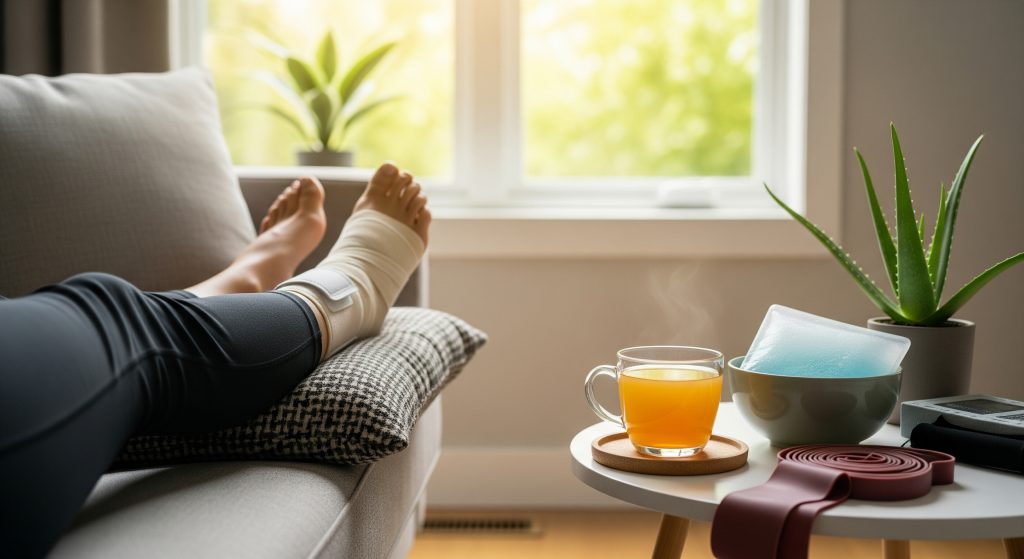
Elevation is more than a comfort play. It uses gravity to assist fluid return and limit pooling. As Mayo Clinic notes, keeping the ankle above heart level is the best practice, especially when paired with compression. I also slide a pillow under the calf to avoid pressure on the heel. This small change improves comfort during longer rests.
If asked how to reduce ankle swelling at home, I start here. Elevate regularly in the first days, and after a long day on the feet. It is simple and effective, which is the hallmark of good ankle pain home remedies.
Compression Wrapping Methods
Compression manages swelling without locking the joint. A well-applied elastic bandage supports tissue fluid movement and reduces that heavy, throbbing feel. As ColumbiaDoctors explains, begin at the toes and wrap in a figure-eight pattern with a snug, comfortable tension that does not cause numbness. I ensure full coverage across the foot and a few inches above the ankle.
-
Check capillary refill at the toes to confirm circulation.
-
Loosen the wrap if tingling, pain, or colour change occurs.
-
Re-wrap once or twice daily to maintain even pressure.
Used with elevation, compression is one of the most practical ankle pain home remedies for day-to-day management.
Turmeric and Ginger Natural Anti-inflammatories
Food-first strategies can complement local care. Turmeric and ginger have credible anti-inflammatory properties that support joint comfort. As Mayo Clinic highlights, curcumin in turmeric can help with inflammatory pain, and it is accessible through cooking, teas, or supplements. I treat these as adjuncts. Helpful, but not a replacement for load management and exercises.
In practice, I add a turmeric-ginger tea in the evening during the early recovery weeks. It is a small ritual that pairs well with elevation and quiet time. These gentle additions give ankle pain home remedies a whole-person feel without drifting into overclaims.
Epsom Salt Soaks for Pain Management
Warm Epsom salt soaks can feel soothing. The warmth relaxes the calf and foot, which may reduce protective muscle guarding. I use them after the acute phase, especially before stretching sessions. Keep the water comfortably warm and limit the soak to about 10 minutes. Then dry the skin and perform your ankle pain relief exercises while tissues are more supple. This is a comfort tool. It does not replace progressive strengthening.
Ankle Pain Relief Exercises and Stretches
Ankle Circles and Rotations
Gentle motion brings nutrients into healing tissue. I start with pain-free ankle circles in both directions, then slow pumps into plantarflexion and dorsiflexion. This helps reduce morning stiffness and supports joint lubrication. Consistent, small sets often beat sporadic long sessions. The same principle underpins effective ankle pain home remedies across the board.
-
Perform slow circles, both clockwise and anticlockwise.
-
Stop short of pain and avoid forcing range.
-
Breathe evenly to prevent muscle bracing.
Calf Stretches for Flexibility
Stiff calves pull on the ankle and limit normal gait. I use two wall stretches. Straight knee for the gastrocnemius and bent knee for the soleus. Hold each with calm breathing. Post-stretch, I often add light foot mobilisation, such as toe scrunches. The goal is efficient movement, not extreme range. That distinction matters for any programme of ankle pain home remedies.
Resistance Band Exercises
Targeted strengthening restores stability. Bands allow inversion, eversion, plantarflexion, and dorsiflexion at controlled loads. I keep the tempo slow and the range pain free. This improves tendon capacity and retrains coordination. If swelling increases after a set, I reduce volume and resume with shorter reps. The right dose keeps ankle pain home remedies productive rather than provocative.
-
Prioritise quality over quantity in each repetition.
-
Anchor the band securely to avoid jerks.
-
Progress colour resistance only when pain remains stable.
Towel Stretches for Morning Relief
Morning tightness is common after sprains. A towel looped under the forefoot lets me apply an even, gentle pull. I hold for a count and then release, repeating a few times. This primes the plantar fascia and calf for the first steps of the day. Done consistently, it complements other ankle pain home remedies by smoothing the transition from rest to movement.
Balance and Stability Exercises
Sprains impair proprioception. Balance training retrains the system. I start with double-leg stance, then progress to single-leg holds near a stable support. Small perturbations like gentle head turns add challenge without risk. This work reduces re-sprain likelihood and helps people trust the ankle again. That confidence is as valuable as any pain scale change.
-
Eyes-open single-leg holds on firm ground.
-
Eyes-closed progressions for advanced stages.
-
Cushioned surface only after firm ground is controlled.
Progressive Weight-Bearing Activities
Tissue adapts to load. I plan a careful progression from partial to full weight bearing, then to functional drills like step-ups and controlled heel raises. If pain lingers after activity, I adjust the dose rather than stopping entirely. This is how ankle pain home remedies evolve into durable function. Measured progress beats all-or-nothing thinking.
Natural Remedies for Ankle Sprains and Swelling
Arnica Gel Application
Arnica gel is popular for bruising and soft tissue soreness. I apply a thin layer around, not on, broken skin. The sensation is mild and can provide short-term comfort. It is best treated as a local adjunct while exercises and load management do the heavy lifting. In that sense, it earns a practical spot among natural remedies for ankle sprain care.
Essential Oil Blends for Massage
Light massage with diluted essential oils may improve comfort and reduce guarding. I stick to simple blends with lavender or peppermint in a carrier oil. The therapeutic effect likely comes from gentle touch and warmth as much as from the oils. Use sparingly, and avoid vigorous rubs over recent sprains. The aim is to nudge relaxation, not to force change.
Cabbage Leaf Wraps
Cabbage leaves are a traditional option for swelling comfort. Chilled leaves contour the ankle and provide a cool compress. Evidence is limited, but as a low-risk method it fits the supportive tier of ankle pain home remedies. Swap the leaves when they warm, and do not use this in place of compression if swelling is pronounced.
Apple Cider Vinegar Compress
An apple cider vinegar compress can feel soothing for some individuals. I dilute it with warm water and apply a short, gentle compress. There is no strong clinical evidence for better outcomes here. Still, if it relaxes the area and encourages consistent self-care, it has a modest role. Always patch test first to avoid skin irritation.
Aloe Vera for Inflammation
Aloe vera gel offers a cooling effect that people often find calming after minor sprains. As ScienceDirect summarises from research, aloe contains compounds with anti-inflammatory actions and can support tissue comfort. I apply a thin layer to unbroken skin, then allow it to absorb before wrapping. It pairs well with elevation and compression in natural remedies for ankle sprain strategies.
Prevention and Long-term Management
Proper Footwear Selection
Footwear is a daily intervention. The right shoe reduces stress, improves alignment, and lowers the chance of repeat sprains. As Mayo Clinic advises, check fit regularly, keep a roomy toe box, and choose a supportive heel counter. For unstable ankles, look for firm sidewalls and a cushioned midsole. I also rotate pairs to avoid worn-out support.
|
Feature |
What to look for |
|---|---|
|
Fit |
Secure heel, wiggle room at toes, no pinching. |
|
Heel counter |
Stiff enough to limit rearfoot wobble. |
|
Midsole |
Cushioned but not unstable on edges. |
|
Outsole |
Good grip to reduce slips on wet or uneven ground. |
|
Activity match |
Trail shoes for uneven paths, supportive trainers for gym. |
Footwear tweaks sound mundane. They quietly prevent setbacks. That is the spirit of smart ankle pain home remedies.
Daily Strengthening Routine
Strength and balance guard against future sprains. I programme short, regular sessions that fit busy days. Think calf raises, soleus raises, tibialis anterior work, and foot intrinsic drills. Proprioceptive work such as single-leg stance anchors the routine. Consistency, not intensity, drives change. It is basically a maintenance dose for ankle resilience.
-
Calf and soleus raises for push-off strength.
-
Ankle inversion and eversion with a band for stability.
-
Single-leg balance to sharpen proprioception.
These habits integrate seamlessly with other ankle pain home remedies, forming a sustainable base.
Dietary Changes for Joint Health
Diet influences inflammation and recovery capacity. I prioritise omega-3 rich fish, colourful fruits and vegetables, and adequate hydration. As Mayo Clinic Press has outlined, a balanced, anti-inflammatory pattern supports joint health and symptom control. It complements local care and exercise. Small daily choices compound into meaningful resilience.
-
Fatty fish, olive oil, nuts, and leafy greens.
-
Limit added sugars and ultra-processed foods.
-
Consider turmeric and ginger in meals for additional support.
When to Seek Medical Help
Self-care has limits. As Mayo Clinic advises, severe pain, visible deformity, inability to bear weight, or worsening symptoms require formal evaluation. Sudden popping at injury, marked bruising, or numbness suggests significant soft tissue or nerve involvement. Early assessment can prevent chronic instability. Ankle pain home remedies work best when used alongside clear thresholds for escalation.
Making Ankle Pain Home Remedies Work for You
There is no single magic fix. Effective ankle pain home remedies blend simple tools applied at the right moment. In the first days, prioritise elevation, compression, and brief icing. Add gentle mobility and protected weight bearing as pain permits. Fold in balance work, band strengthening, and smart footwear. Use natural supports like turmeric, ginger, and aloe as adjuncts, not anchors.
Two practical examples help. After a mild sprain, I might prescribe elevation in the evenings, a figure-eight wrap during the day, ankle circles twice daily, and short single-leg balance near the kitchen bench. For a recurrent sprain, I add banded inversion and eversion, a firmer shoe with a stable heel counter, and a structured return-to-walk plan. Both are ankle pain home remedies in action. Simple, repeatable, and grounded in tissue behaviour.
And yet, the plan only works if it fits the week ahead. I encourage setting small, non-negotiable slots for mobility and balance. Then adjust loads around them. That is how ankle pain home remedies become habits, not hopeful one-offs.
Frequently Asked Questions
How long should I apply ice to reduce ankle swelling?
Short, frequent sessions are safest. I typically suggest 10 to 15 minutes per session with at least an hour between applications. Protect the skin with a thin towel. Use cold in the first 24 to 48 hours after injury, then as needed for flare-ups. Combine with elevation and compression for better effect. This is the most efficient route inside ankle pain home remedies for early swelling control.
Can children safely use these ankle pain home remedies?
Yes, with supervision and sensible dosing. Use gentle compression, brief cold applications, and age-appropriate mobility drills. Avoid intense stretches and high resistance in the early phase. If a child cannot bear weight or pain escalates, seek medical advice. Children recover quickly when supported by calm, consistent care. These ankle pain home remedies should remain simple and comfortable.
Which natural remedy works fastest for ankle sprain recovery?
Relief, not speed, is the honest answer. Elevation plus compression changes swelling fastest. Aloe gel can cool the skin. Turmeric and ginger may support comfort over days, not minutes. The true accelerator is progressive loading and balance training once pain allows. That is the engine of recovery within natural remedies for ankle sprain frameworks.
How often should I perform ankle pain relief exercises?
Little and often works best. Short mobility sessions twice daily are reasonable early on. Strength and balance can run three to five days per week as pain settles. If symptoms spike the day after, reduce volume and resume. This cadence keeps ankle pain home remedies effective without provoking setbacks.
When should home remedies be replaced with medical treatment?
Escalate care if pain is severe, if the ankle looks misshapen, or you cannot put weight through it. Worsening swelling, spreading bruising, or numbness also warrants evaluation. If home care shows no improvement within a few days, book an assessment. Ankle pain home remedies sit inside a broader safety net. Use that net when red flags appear.
Are there specific remedies for chronic versus acute ankle pain?
Yes. Acute pain favours calm, protective care: RICE, elevation, and gentle motion. Chronic pain leans on strengthening, balance training, and footwear refinement. Natural supports like turmeric and ginger can sit in both plans as adjuncts. The distinction is about timing and load progression. That is where ankle pain home remedies become precise rather than generic.
Final note: If in doubt, pare it back to three anchors. Elevate and compress. Move gently every day. Progress load in small steps. These anchors keep ankle pain home remedies reliable, even when life is busy.

